

The New Competition for Capital. What Higher Yields Could Mean for Business
15th September 2026
The US National debt has been a topical issue for CFO’s and Treasury teams since the announcement.
While many look to the 40 trillion-dollar headline, the more significant issue for the economy may be the cost of servicing that debt, particularly if borrowing costs remain elevated while governments and businesses continue to compete for capital.
The Congressional Budget Office projects US federal net interest outlays will increase from around $1 trillion in 2026 to $2.1 trillion by 2036, growing at an average annual rate of 7.5%.
In FY2025, net interest spending of $970 billion was already higher than national defence outlays. By 2036, net interest costs are projected to reach 4.6% of GDP and account for nearly one-fifth of all federal spending.
But, the US is also part of a much broader debt story.
The IMF estimates global public debt reached almost 94% of GDP in 2025 and could reach 100% by 2029. Governments are facing growing spending requirements across defence, infrastructure and social programmes, while interest costs are also increasing. For businesses, the issue extends beyond government finances. If the global cost of capital remains higher for longer, it could influence funding decisions, investment returns, refinancing and liquidity right across the corporate sector.
And that’s just scratching the surface.
The changing cost of capital
Long-term yields reflect expectations about future interest rates, inflation and economic growth, as well as factors such as government borrowing, investor demand, term premiums and broader market conditions.
This matters because short-term interest rates and long-term yields do not always move in the same direction. A reduction in short-term interest rates does not necessarily translate into lower long-term funding costs. For businesses considering refinancing, acquisitions or capital expenditure, the cost of long-term capital can therefore be more relevant than the next move in the cash rate, and the effects are not confined to the US. 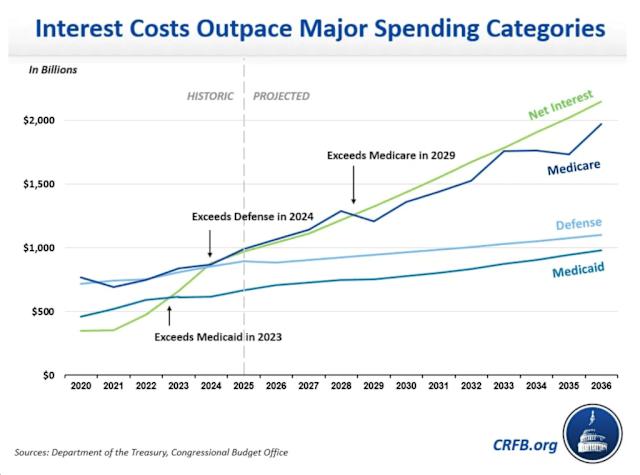
Chart showing US federal net interest costs projected to surpass Medicare, defence and Medicaid spending, reaching nearly $2 trillion by 2036.
For companies with offshore debt, foreign currency exposure or significant refinancing requirements, global funding conditions can have a direct bearing on financial planning.
However, higher debt does not automatically mean higher yields forever.
Higher levels of government debt do not automatically translate into persistently higher long-term yields
Inflation, economic growth, investor demand, monetary policy expectations, term premiums and geopolitical developments can all influence yields.
Economic growth itself can push yields higher. Expectations of stronger productivity from AI, for example, could support higher growth and investment while also increasing demand for capital.
That makes the outlook more complicated than a simple relationship between government borrowing and interest rates.
It reinforces the limitations of relying on a single rate assumption. Forecasts need to remain useful across a range of possible market conditions, including scenarios where growth, inflation, funding costs or liquidity requirements develop differently from expectations.
What does this mean for treasury forecasting?
The immediate implications are familiar and can all change as market conditions evolve.
But the broader debt environment adds another consideration. How much of the current forecast depends on today’s funding conditions continuing?
A business may have a clear view of its current debt costs, but that does not necessarily tell it what refinancing will cost when facilities mature. The same applies to investment decisions. A project that works at one cost of capital may look very different if funding costs remain elevated.
This raises a broader conversation about what the US debt trajectory could mean for the economy.
Who will compete for capital as government borrowing remains high and investment demand accelerates? What happens to the cost of funding the next wave of AI, infrastructure and energy investment if long-term yields remain elevated? And how much of the existing debt will eventually need to be refinanced at higher rates?
These questions are increasingly interconnected, and together they could play a large part in the cost of capital and investment decisions across global markets.
1. The Competition for Capital
Governments are not the only borrowers looking for capital.
The US government needs to continually raise funding while businesses are investing in AI, infrastructure, energy and defence. Other governments face their own spending and investment requirements.
There are also signs that the global economy may be entering a more investment-intensive period. Recent commentary has pointed to a shift away from the excess global savings environment of previous decades towards stronger investment demand, including spending on AI infrastructure.
For businesses, that raises a practical capital allocation issue.
If investors can earn attractive returns from government bonds, what return does a corporate investment need to generate to remain competitive? If the cost of capital stays elevated, which projects continue to meet investment hurdles?
This could put greater emphasis on the timing and prioritisation of capital expenditure. Businesses may find themselves assessing opportunities more closely at a time when the scale of potential investment is also increasing.
2. AI, infrastructure and the cost of investment
AI is one of the clearest examples of this shift.
The next phase of AI investment requires considerably more than computing capacity. Data centres need power, transmission infrastructure and supporting networks. Semiconductor production requires substantial investment, while the energy demands associated with data centres are adding pressure to existing infrastructure.
The RBA has noted that the scale of borrowing required to fund future AI-related infrastructure investment could itself become a source of financial vulnerability.
The Stargate Project alone has been linked to plans for up to US$500 billion of investment in AI infrastructure, highlighting the scale of capital required to support the next phase of development.
There is an interesting financial question underneath the technology story.
The investment required to support future productivity growth is arriving at a time when the cost of financing that investment may be higher than businesses have been accustomed to.
That does not make the investment any less compelling, but it does mean the financial case needs to be tested against the new funding environment.
CFOs may need to consider whether projected returns adequately compensate for funding costs, how quickly investment is expected to generate cash returns and whether the balance sheet can accommodate a larger investment programme.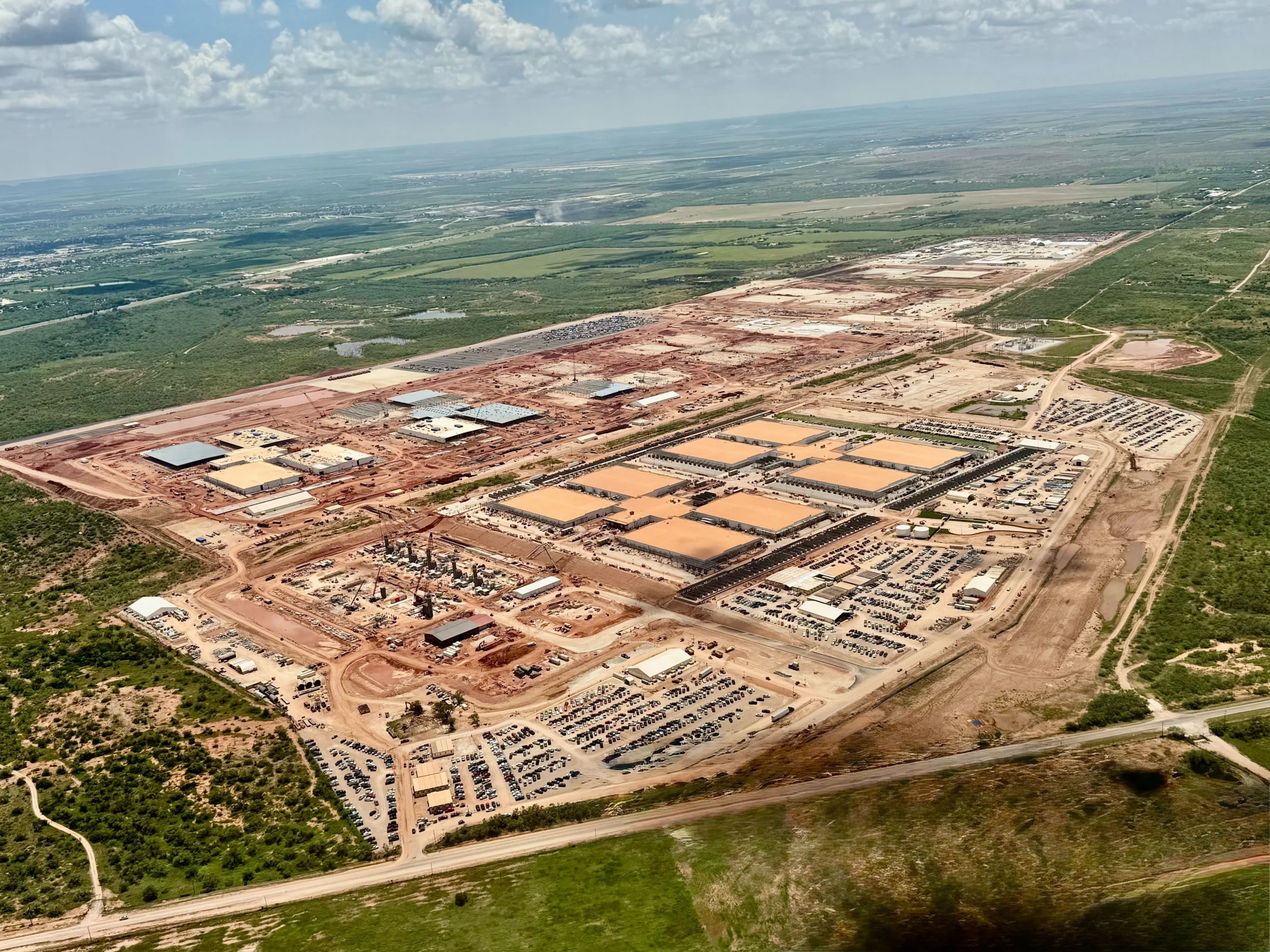
Stargate I site in Abilene, Texas
3. When yesterday’s debt meets tomorrow’s rates
For many businesses, the most immediate issue may be refinancing rather than new borrowing.
Debt that looks manageable today can become more expensive when it matures and needs to be replaced. The IMF notes that global interest expenditure has risen from around 2% to almost 3% of GDP in just four years as governments refinance maturing debt at higher market rates.
The same principle applies at a corporate level.
Treasury teams need to know what is maturing, when it needs to be refinanced and how sensitive the business is to changes in funding costs. A company with substantial debt falling due over the next few years may have very different liquidity and cash flow requirements from one with a longer-dated funding profile.
A 100 basis point change in refinancing costs can be modelled. The harder part is understanding what that change means for the rest of the business.
Does it reduce investment capacity? Change liquidity requirements? Alter hedging decisions? Affect covenant headroom? Change the return expected from a major project?
Those are the connections treasury needs to see.
The bigger question
While the $40 trillion US debt figure makes for a striking headline, the more important issue for businesses is what happens when governments, companies and major investment programmes all need capital at the same time.
The outcome is far from certain. Long-term yields could be influenced by stronger growth, inflation, investor demand, fiscal policy or a combination of factors. But uncertainty around the direction of yields does not remove the need to understand the exposure.
For CFOs and treasury leaders, the focus should be on how changes in the cost and availability of capital could affect the business.
No treasury team can predict every change in global markets. It can, however, make sure that when those changes occur, the business has the information and financial visibility to respond.
That means knowing where cash is, understanding debt and refinancing requirements, keeping sight of financial exposures and testing the assumptions behind forecasts.
Article Source:
FiscalData – Debt to the Penny
https://fiscaldata.treasury.gov/datasets/debt-to-the-penny/debt-to-the-penny
The Budget and Economic Outlook: 2026 to 2036
https://www.cbo.gov/publication/62105
Fiscal Policy under Pressure: High Debt, Rising Risks
https://www.imf.org/en/publications/fm/issues/2026/04/15/fiscal-monitor-april-2026
The Global Macro-financial Environment
https://www.rba.gov.au/publications/fsr/2026/mar/the-global-macro-financial-environment.html
Reuters – Bond market may be pricing AI productivity gains as yields rise: JPMorgan Private Bank
https://www.reuters.com/world/bond-market-may-be-pricing-ai-productivity-gains-yields-rise-jpmorgan-private-2026-08-28
IMF – War Shock Requires Disciplined Fiscal Reaction
https://www.imf.org/en/blogs/articles/2026/04/15/war-shock-requires-disciplined-fiscal-reaction
IEA: Energy and AI
https://www.iea.org/reports/energy-and-ai
Reuters – Fed’s Warsh says past global savings glut is turning into investment surge
https://www.reuters.com/business/finance/feds-warsh-says-past-global-savings-glut-is-turning-into-investment-surge-2026-08-31
Stargate advances with 4.5 GW partnership with Oracle
https://openai.com/index/stargate-advances-with-partnership-with-oracle/